Director’s Message
Welcome, and thank you for taking the time to learn more about the Hawaiʻi Marine Energy Center (HMEC). Founded in 2009 to conduct research into wave and ocean thermal energy, and to facilitate the establishment of the U.S. Navy’s Wave Energy Test Site (WETS), our small group has supported numerous graduate students, undertaken wide-ranging research projects, and continued to facilitate positive outcomes at WETS.
HMEC exists because Hawaiʻi—and island and coastal communities like ours—sit at the front edge of both the challenges and opportunities of the global energy transition. Living and working in Hawaiʻi makes the realities of energy security, resilience, and sustainability very tangible. Those realities shape how we think about marine energy, how we conduct research, and how we engage with communities, industry, and partners across the Pacific.
At HMEC, we work at the intersection of science, engineering, and real-world application, with an emphasis on taking our work from robust numerical studies, validated through extensive laboratory/bench testing, and ultimately into real-world in-ocean tests and demonstrations. Our role is to advance marine energy technologies, while ensuring we do so in ways that are grounded in our island communities, informed by experience, and responsive to the needs of those communities we wish to serve. That means listening carefully, collaborating broadly, and ensuring that innovation is paired with responsibility.
Whether you are a researcher, student, developer, policymaker, or simply someone curious about the future of energy in Hawaiʻi and beyond, I invite you to explore our work and connect with us. We see marine energy not as an abstract solution, but as a practical opportunity to build a more resilient and sustainable future—here in Hawaiʻi and across island and coastal regions worldwide.
— Patrick S. Cross, PhD

About…
The National Marine Energy Centers (NMECs) are a U.S. Department of Energy–supported network of university-led centers advancing marine energy through research, testing, and workforce development. Established beginning in 2008, the NMECs are strategically located along U.S. coastlines to reflect the nation’s diverse wave, current, and ocean environments.
Together, the NMECs support marine energy innovation by advancing foundational science, operating laboratory and open-ocean testbeds, and training a skilled workforce. As illustrated in the accompanying graphic, the network spans more than 40 testing and research capabilities nationwide.
The Hawaiʻi Marine Energy Center (HMEC) is the NMEC serving Hawaiʻi and the U.S.-Affiliated Pacific Islands (USAPI). Based at the University of Hawaiʻi at Mānoa within the Hawaiʻi Natural Energy Institute (HNEI), HMEC focuses on marine energy challenges and opportunities unique to islanded, remote, and coastal communities, with a particular emphasis on wave and ocean thermal energy.
HMEC’s role within the NMEC network is defined by:
Research and testing in deep-water and island-relevant wave environments
Integration of laboratory, nearshore, and open-ocean capabilities in Hawaiʻi
Leadership in community engagement, workforce development, and regional partnerships across the Pacific
By grounding national marine energy objectives in Hawaiʻi’s physical, cultural, and energy-system context, HMEC helps ensure that technologies developed through the NMEC program are applicable not only at utility scale, but also where energy resilience and local impact matter most.
The United States Affiliated Pacific Islands (USAPI)
The United States–Affiliated Pacific Islands (USAPI) include Guam, the Commonwealth of the Northern Mariana Islands, American Samoa, and the Freely Associated States—the Republic of Palau, the Federated States of Micronesia, and the Republic of the Marshall Islands. Across these islands, communities share common realities as island and ocean-dependent societies: geographic isolation, high energy costs, logistical constraints, and deep cultural and economic connections to the marine environment.
While HMEC is not currently structured to formally include the USAPI, we view these island communities as Pacific neighbors and welcome opportunities for collaboration and knowledge sharing. Through Hawaiʻi’s geographic proximity and long-standing regional relationships, HMEC is well positioned to serve as a technical resource and collaborative partner for marine energy–related research, testing, and capacity building.
When welcomed, this collaboration may include sharing technical expertise, lessons learned, data, training opportunities, and connections within the broader U.S. marine energy network. HMEC’s intent is to support locally driven, context-appropriate solutions that advance energy resilience and sustainability across island and coastal communities in the Pacific.
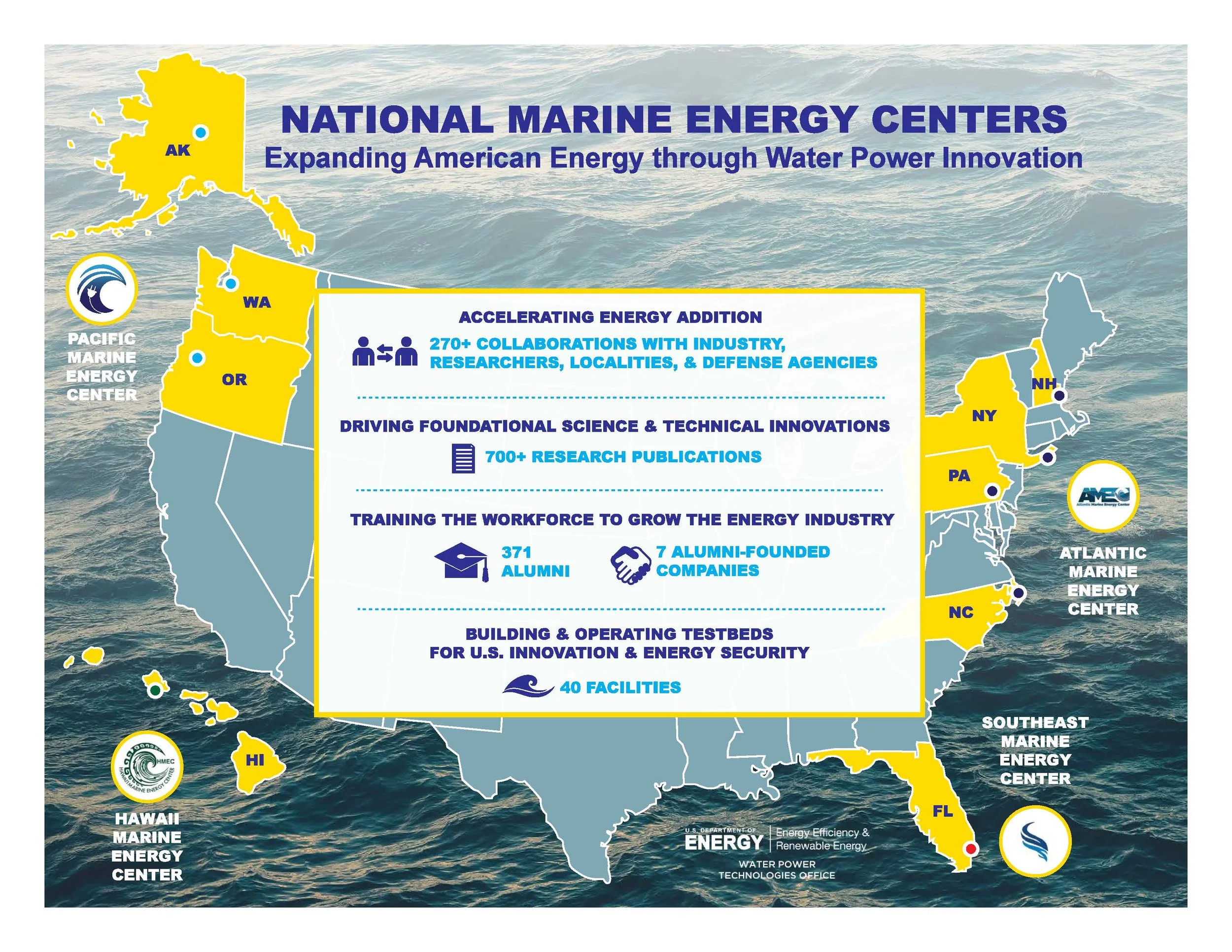
HMEC works in close coordination with the other National Marine Energy Centers, each of which contributes distinct geographic and technical strengths to a shared national mission:
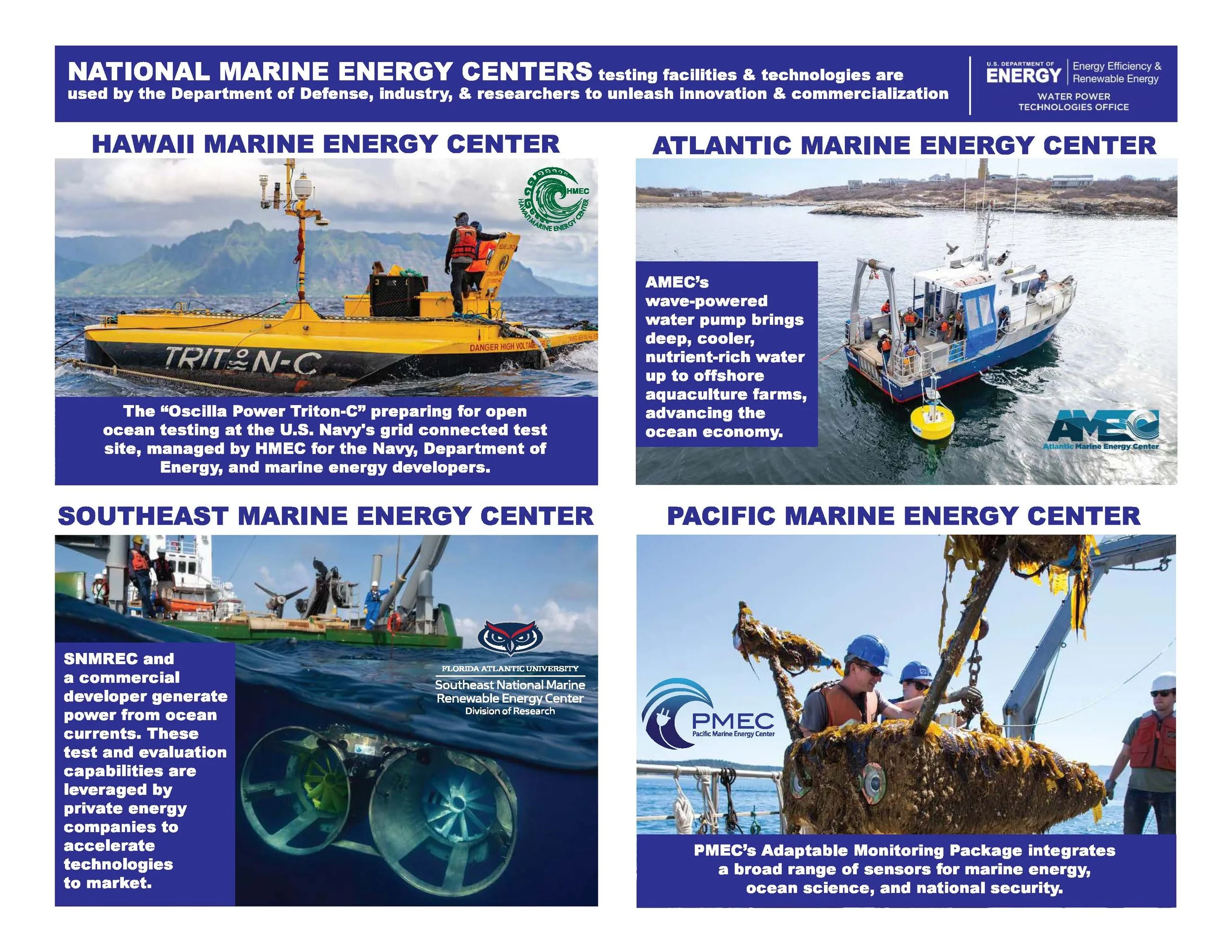
Atlantic Marine Energy Center (AMEC) advances wave and current energy research along the U.S. East Coast, with strengths in coastal applications and blue-economy innovation.
Pacific Marine Energy Center (PMEC) provides large-scale wave energy testing and instrumentation in the Pacific Northwest, including offshore and grid-connected facilities.
Southeast National Marine Renewable Energy Center (SNMREC) specializes in ocean currents and offshore thermal resources, while also supporting the testing and evaluation of emerging marine energy technologies in southeastern U.S. waters.
Rather than operating independently, the NMECs function as an integrated national network—aligning research priorities, sharing facilities and data, coordinating education and outreach, and jointly supporting developers as technologies progress from concept to deployment.
This coordinated approach allows technologies to be evaluated across multiple regions and operating conditions, strengthening confidence in performance, reliability, and scalability before deployment.
HMEC’s Pacific and island perspective complements the continental strengths of the other centers, ensuring that marine energy solutions are robust across regions, scales, and use cases.
HMEC History
The Hawaii National Marine Renewable Energy Center (HINMREC) was established under Department of Energy (DOE) funds in 2008 as one of three national centers tasked with advancing marine energy in different parts of the country – together with the Northwest (now called the Pacific Marine Energy Center (PMEC)) and Southeast NMRECs. Between 2009 and 2019, HINMREC conducted a wide range of research and developmental support related primarily to ocean thermal energy (OTEC) and wave energy. Specifically, HINMREC supported the Naval Facilities Engineering Command (NAVFAC) in the expansion of the Wave Energy Test Site (WETS) from a single test berth to the three test berths. HINMREC also supported substantial research related to OTEC resources and impacts assessments, as well as wave energy resource assessments around the Hawaiian Islands, including wave resource modeling, wave field measurements (at WETS and elsewhere) and data analysis, wave forecasting, and operational wave analysis. Environmental impact monitoring conducted at WETS included: acoustic signature measurements; ocean current and wave measurements with ADCPs; sediment transport analysis and field surveys; ecological and seawater chemical analysis surveys; and seafloor and bathymetric surveys to support the Navy’s Environmental Assessment (EA). HINMREC also supported early WEC device performance assessments, including both device survivability and power performance. Other studies included: operational models for WEC arrays, alternate mooring designs, and aluminum corrosion studies associated with OTEC. Though foundational funding was exhausted in 2019, HINMREC has continued to act as one of DOE’s centers of expertise related to marine energy, with a particular emphasis on wave energy and activities at WETS.
Outlook
The work at the University of Hawaii in support of WETS will continue to be an important contributor to the vision and expertise accumulated at HMEC. Involvement with wave energy converter (WEC) developers, DOE, NAVFAC, developers of environmental sensing packages, State agencies, and other WETS stakeholders will inform research and other priorities within our group. This exposure to real-world WEC deployment challenges puts HMEC in a unique position to develop research and outreach efforts that are well informed by practicalities, but also well founded in fundamental research. Our close relationships with Hawaii (and national) supply chain companies and local marine services providers will also continue to be important in shaping our vision for HMEC. That vision could be summarized as: Expand our knowledge of fundamental marine energy principles, communicate that knowledge as widely as possible, and keep a steady eye toward the real-world practicalities of our solutions.